Qwen4-Max: cheaper per task, built for long jobs.
Alibaba's Qwen4-Max pairs a 2.4T backbone (71B active per token) with native vision and a 1M-token context. International list pricing drops to $1.5/$4.5 per million input/output tokens from $2/$6, and Qwen says average cost per task on its own Work360 benchmark falls 62%. No open Max weights announced.
On November 15, 2026, Alibaba's Qwen team introduced Qwen4-Max, the first model of its new Qwen4 family. Qwen calls it "your new AI teammate" for work, creativity and discovery. The headline specs: a 2.4-trillion-parameter backbone with 71 billion parameters active per token, plus an additional 328 billion parameters in a new N-gram embedding layer. It has native vision and a one-million-token context window.
The model is available now on QwenCloud, through either the Token Plan or the API, and inside QwenWork, Qoder and Qwen Studio. On Alibaba Cloud Model Studio's international pricing, Qwen4-Max lists at $1.5 per million input tokens and $4.5 per million output tokens, down from $2 and $6 for Qwen3.8-Max. Cache reads list at $0.075 per million tokens.
Why this is interesting
Cost per finished task, not just per token. Qwen's strongest claim is about efficiency. On Work360, its own benchmark of professional tasks, Qwen says Qwen4-Max uses about 24% fewer tokens at its "Xhigh" effort setting and about 35% fewer at "High" effort than Qwen3.8-Max. On Terminal-Bench 4.0 the reductions are about 48% and 49%. Combine fewer tokens with lower prices, and Qwen says the average cost per Work360 task drops from $4.43 to $1.67, a 62% reduction. For anyone running agents on long jobs, that is the number that counts: what a finished piece of work costs, not what a token costs.
A new architecture, not just a bigger checkpoint. Qwen4 changes how the model handles long inputs. Qwen describes a mix of Gated DeltaNet layers, which compress history into fixed-size states, and a new Qwen Sparse Attention that only looks at the relevant parts of a long context. Qwen says this cuts attention costs on long sequences, and that the 2.4T training run had no loss spikes. On its in-house tests, the base model beats Qwen3.8-Max-Base in every domain while activating 25% fewer parameters.
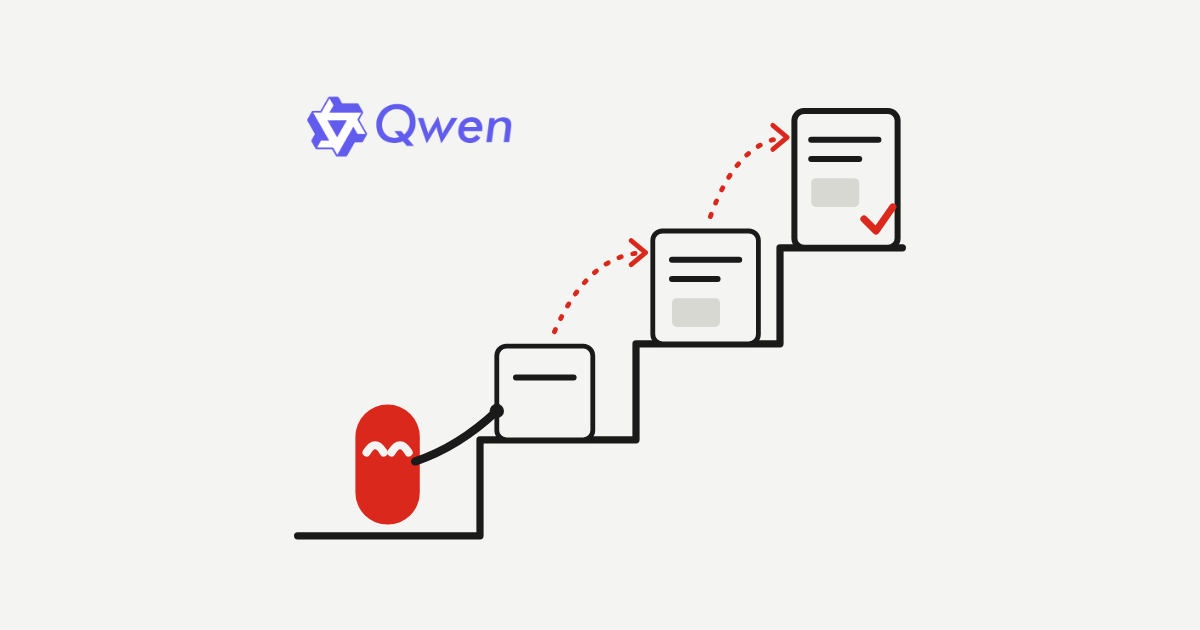
Delivering in stages. Qwen pitches Qwen4-Max for "24/7 agents" and pairs it with a feature called Live Delivery. Instead of disappearing for hours and returning one final result, the agent ships a usable first version early, then improves it through further releases. Users can step in at any point to correct mistakes or change direction. Qwen is open-sourcing a Live Delivery plugin so others can try the pattern. This is a sensible answer to a real problem: when a long agent run goes wrong at the start, you want to find out early, not at the end.
Professional showcases. The post walks through finance, legal due diligence and critical-care examples, including an agent sorting 198 messy working papers into folders and a cited report. These are demos, but they show where Qwen is aiming: long, document-heavy office work.
What it is not
It is not independent testing. Work360 is Qwen's own benchmark and taxonomy (26 domains, 182 subdomains, 721 specialised fields), and the score of 52.69 against 47.74 for Qwen3.8-Max comes from Qwen's setup. The token and cost savings are measured on that same benchmark. Some other comparisons in the post cite outside leaderboards, but the headline efficiency claims are vendor-reported.
It is not an open-weight release. Qwen says smaller Qwen4 models are coming to open source, but gives no date, and the post does not announce open weights for Qwen4-Max itself.
It is not a replacement for professional judgment. Qwen's own ethics statement says the model is meant to assist people, and that human expertise and oversight remain essential where decisions carry serious consequences. The medical and legal showcases should be read in that light.
Pricing also has fine print. Model Studio lists different prices by deployment region, and cache writes cost more than standard input. Check the region you would actually use.
Bottom line
Qwen4-Max is a real generational step from Alibaba: a new architecture, native vision, a million-token context and lower list prices than Qwen3.8-Max. The most useful claim is the 62% drop in cost per task, but it rests on Qwen's own benchmark. If you run long agent jobs, test Qwen4-Max on your own tasks, measure tokens and cost per finished result, and see whether staged delivery catches mistakes earlier. Teams waiting for something they can host themselves should watch for the smaller open Qwen4 models instead.
Sources
3 sources. Each opens the original page.
More where this came from
One email per brief. Mechanisms, numbers, second-order effects.